



Own hosting, code, content and customer data without a locked storefront model.
WOOCOMMERCE DEVELOPMENT COMPANY
WooCommerce stores built for conversion, flexibility and scalable growth.
AppsLoading designs and develops custom WooCommerce stores across storefront UX, product discovery, checkout, subscriptions, B2B, payments, shipping, ERP integrations, migrations, performance and long-term support.
✓ Custom themes and blocks✓ Checkout and conversion UX✓ Payments, shipping and ERP✓ B2B and subscriptions
OwnYour store, content and customer dataExtendPlugins, APIs and custom workflowsScaleCatalogue, orders, channels and operations
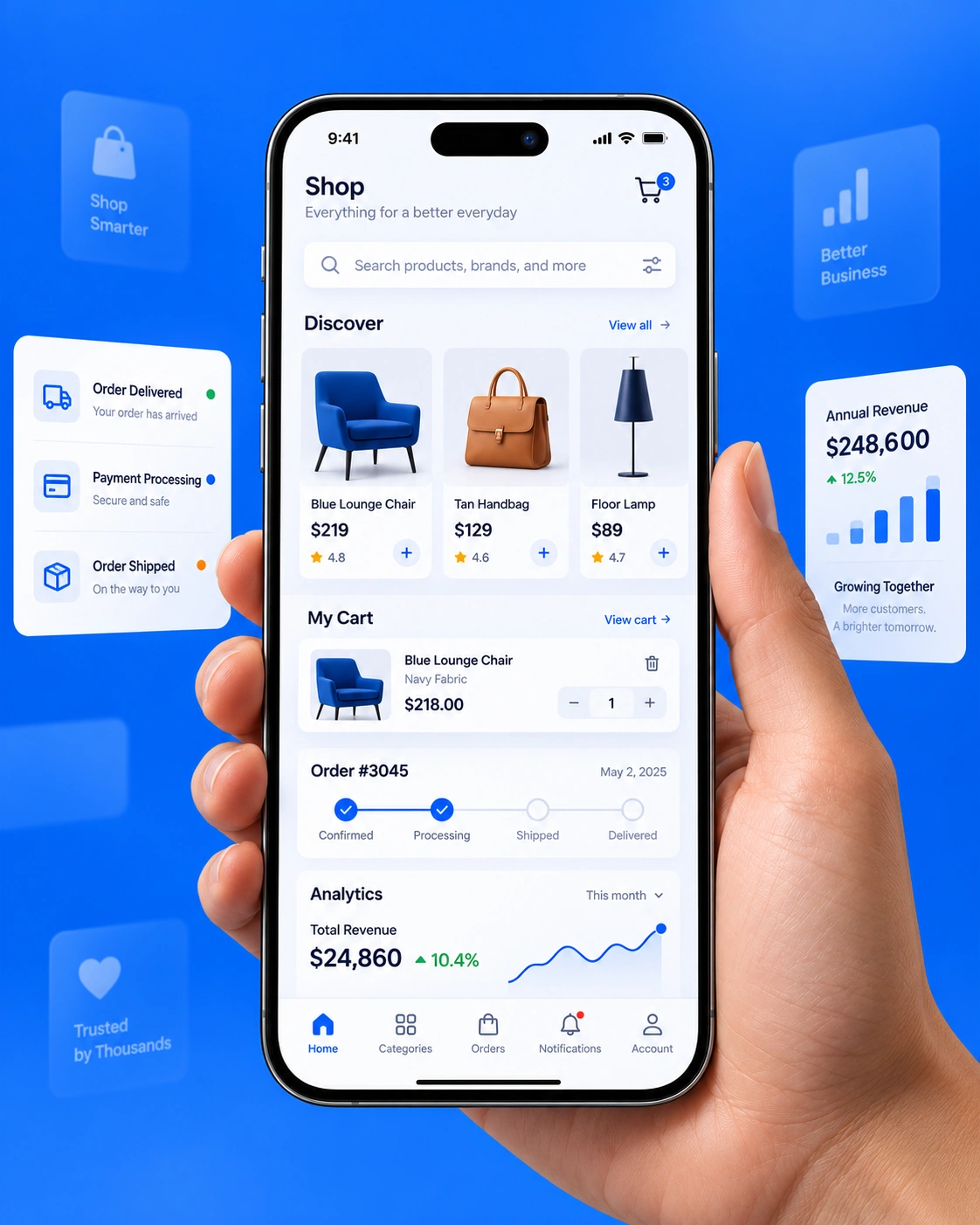
Product discovery, product detail, cart and checkout designed as one customer journey.
Payments, shipping, ERP, CRM, inventory and fulfilment connected to store workflows.
Add subscriptions, B2B, marketplaces, automation and new channels as needs evolve.
START WITH THE BUYING SYSTEM
Build the store around how customers buy and how operations fulfil.
The storefront, checkout and backend should be designed together. AppsLoading maps the full commercial journey before deciding themes, extensions or custom code.
Discover
Collections, search, filters, merchandising, campaigns and landing pages help shoppers reach relevant products.
Evaluate
Product media, variants, pricing, reviews, stock, delivery and trust signals reduce uncertainty.
Convert
Cart, checkout, shipping, payments and order confirmation remove avoidable purchase friction.
Operate
Orders, stock, returns, fulfilment and customer data move through connected business systems.
Retain
Accounts, subscriptions, loyalty, replenishment, reorder and post-purchase communication drive repeat value.
STOREFRONT EXPERIENCE
Make the shopping experience feel designed, not assembled.
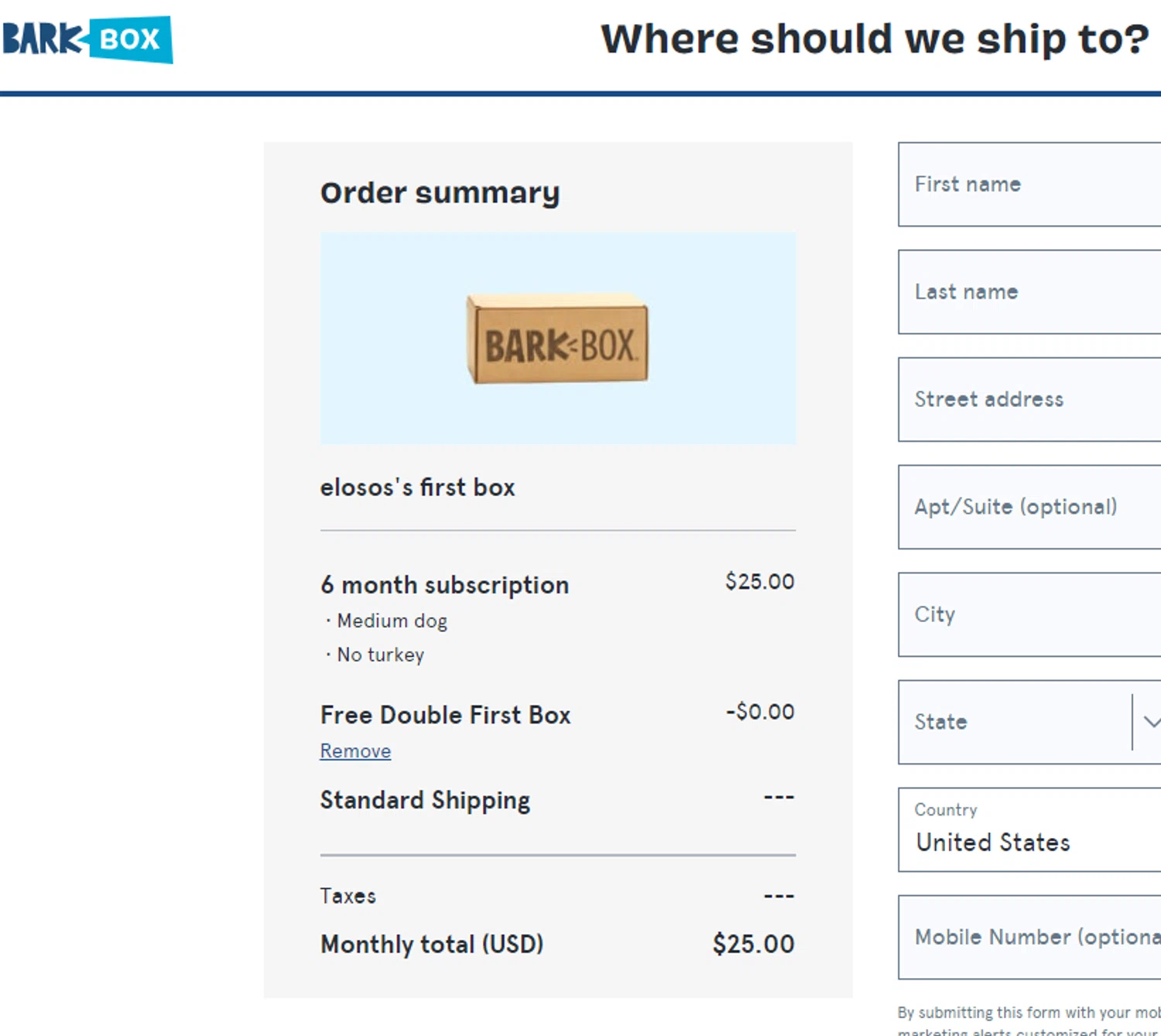
Premium commerce comes from deliberate hierarchy, merchandising, product storytelling and checkout continuity—not from stacking plugins on a generic theme.

Media, variants, fit, material, delivery and trust should work together.

WOOCOMMERCE DEVELOPMENT SERVICES
A complete commerce team, without turning the page into a list of plugins.
Engage AppsLoading for a full store build or a focused stage where your current platform needs stronger UX, engineering or operations.
Commerce strategy & architecture
Catalogue model, customer roles, checkout logic, integrations, hosting, content and roadmap decisions.
Custom storefront design & development
Responsive product discovery, product detail, cart, checkout, account and campaign experiences.
Custom themes, blocks & components
Purpose-built WordPress themes and Gutenberg blocks with performance and maintainability in mind.
Plugin & API engineering
Custom business logic, REST APIs, webhooks, third-party services and operational automation.
Subscriptions, memberships & gated commerce
Recurring billing, renewals, plan changes, failed payment recovery and member access rules.
B2B & wholesale commerce
Account approval, negotiated pricing, tax rules, minimum quantities, quotes and fast repeat ordering.
Migration & replatforming
Products, customers, orders, content, redirects, SEO data and operational workflows moved with validation.
Performance, security & ongoing support
Theme/plugin optimisation, database work, caching, monitoring, updates, security and continuous improvement.
CHECKOUT ARCHITECTURE
Design the highest-risk conversion step as a system, not a form.
Checkout connects customer details, tax, shipping, payments, discounts, stock and order creation. Every dependency should be intentional because failures here become lost revenue and support work.
Customer & address
Required fields, guest checkout, saved details, address validation and account creation.
Delivery & inventory
Zones, methods, pickup, real-time rates, stock rules and delivery expectations.
Payment orchestration
Razorpay, Stripe, PayPal, COD, wallets, authentication and failure recovery.
Order confidence
Order summary, taxes, discounts, policies, confirmation and clear next steps.

CATALOGUE & MERCHANDISING
A catalogue should help customers find, compare and trust.
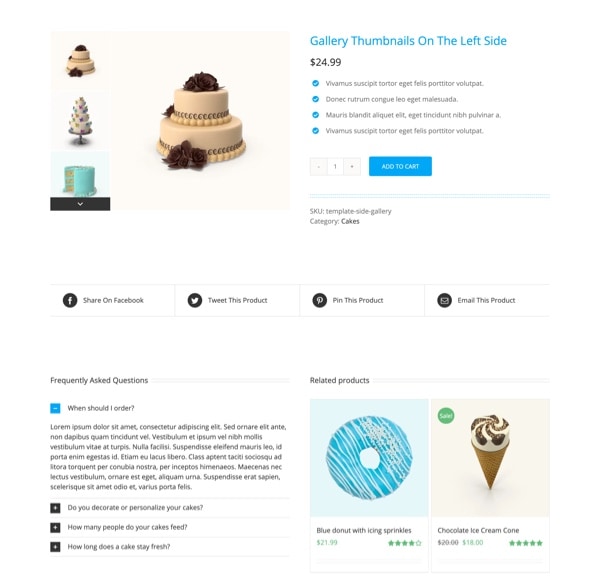
We structure products around real buying behavior: the way people search, filter, compare variants, evaluate specifications and understand availability.
Search & filtering
Categories, attributes, filters, search and merchandising rules that match the catalogue.
Variants & bundles
Simple, variable, grouped, bundled and configurable products with understandable selection.
Availability & delivery
Inventory, backorders, estimated delivery and fulfilment expectations shown at the right point.
Cross-sell & promotions
Related products, bundles, upsells, coupons and campaigns that support rather than interrupt purchase.
RECURRING & B2B REVENUE
WooCommerce can support more than one-time retail transactions.
We extend the platform around recurring revenue, memberships, wholesale and account-specific business rules when those models are core to the product.

SUBSCRIPTIONS & MEMBERSHIPS
Design the full recurring lifecycle, not only the first payment.
Plans, trials, renewals, failed payments, upgrades, skips, cancellation, gated access and self-service account management.
Recurring billingPlan changesDunningMember accessRetention
B2B & WHOLESALE
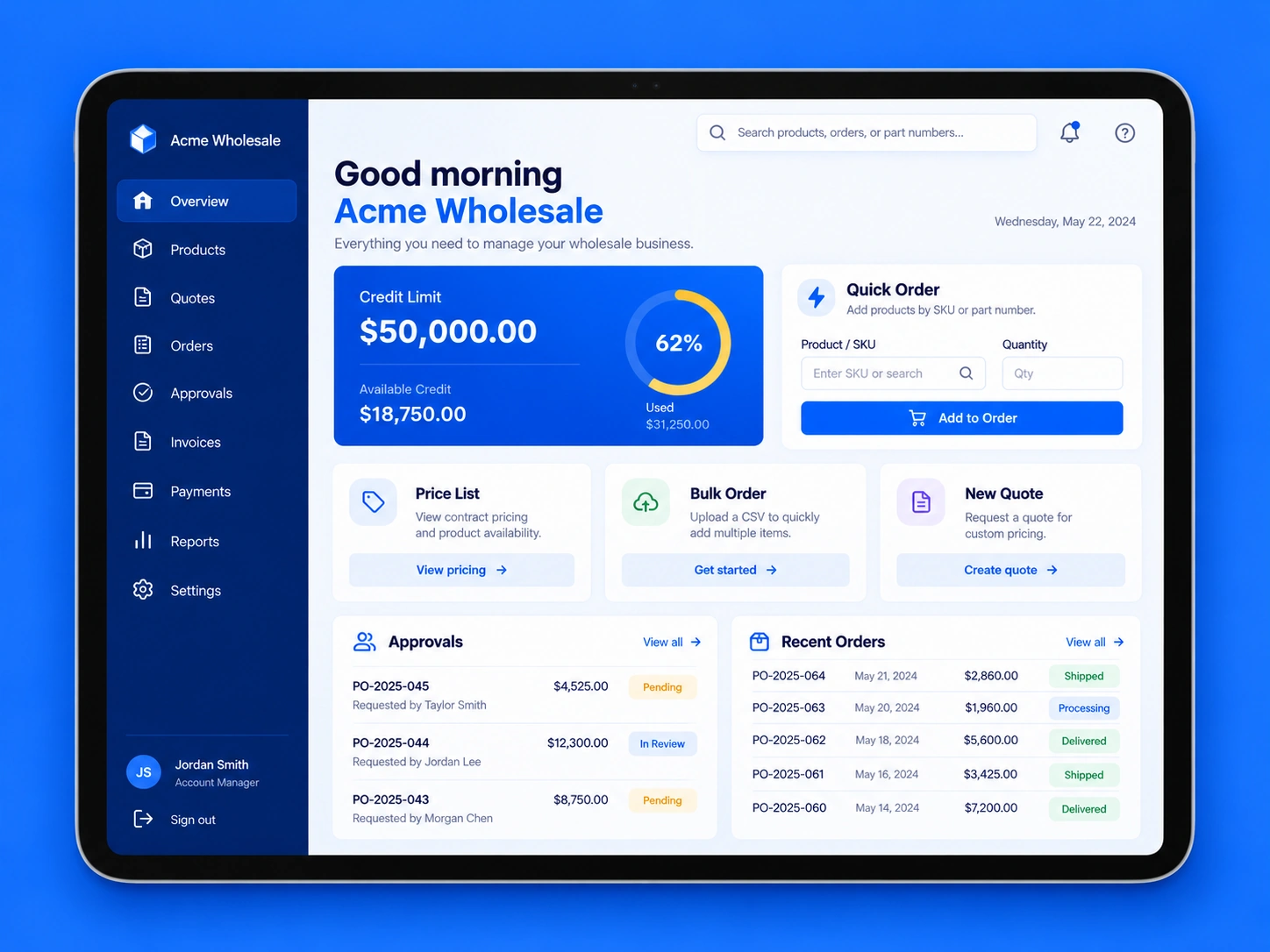
Give business buyers the speed they expect from repeat purchasing.
Approved accounts, negotiated pricing, quotations, purchase orders, minimum quantities, tax rules, bulk order entry and fast reorder.
Account pricingBulk orderingQuotesApprovalsReorder

OPERATIONS & FULFILMENT
Connect the storefront to the systems that actually move the order.
A commerce build is incomplete if inventory, fulfilment, customer service and finance still rely on manual reconciliation. We design the data flow around operational ownership.
Inventory
Stock sync, reservations, low-stock rules and multi-location inventory.
Shipping
Zones, rates, courier APIs, labels, tracking and fulfilment status.
ERP / CRM
Customers, products, orders, invoices and account data exchanged reliably.
Returns
Refunds, return status, exchanges and customer communication.
Tax & finance
Tax rules, invoice flows, payment reconciliation and reporting.
Automation
Webhooks, scheduled jobs and business rules that reduce manual work.
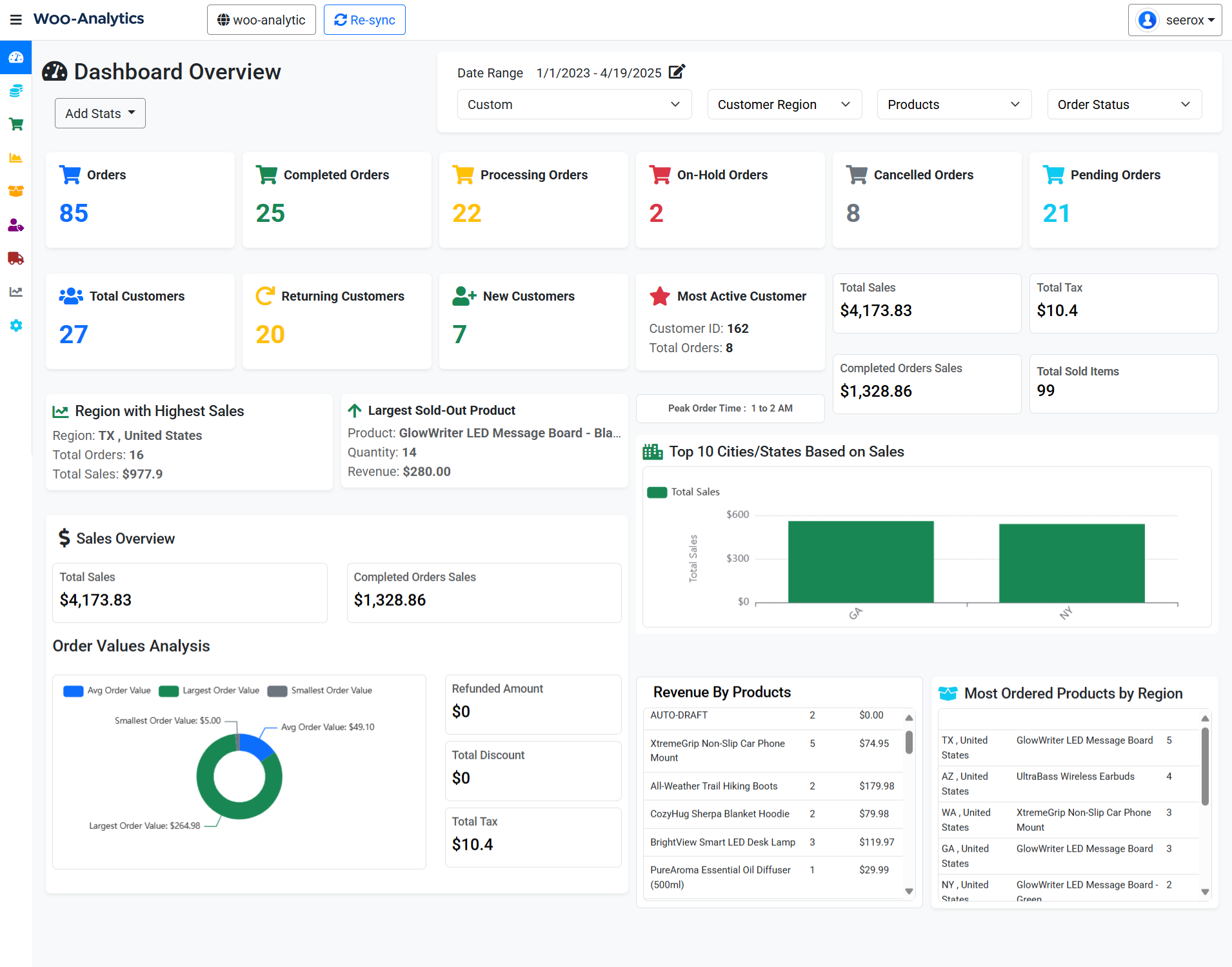
PERFORMANCE & COMMERCE ANALYTICS
A fast store is not enough. You need to know what is slowing customers and operations down.
We connect performance work with observable commerce outcomes—page speed, checkout stability, API latency, inventory calls, payment errors and funnel behavior.
Images, JavaScript, CSS, rendering, caching and Core Web Vitals.
Queries, indexes, transients, sessions, order tables and scheduled jobs.
Gateway latency, AJAX requests, third-party calls and failure logging.
GA4 events, funnels, order data, attribution and operational dashboards.
STORE MIGRATION
Move platforms without treating migration as a spreadsheet import.
A reliable migration protects commerce continuity: catalogue structure, customer accounts, order history, redirects, search visibility, integrations and launch reconciliation.
Map source data and business rules
Products, variants, categories, customers, orders, discounts, taxes, media and custom fields.
Build the target model
Clean structures, resolve incompatible data and define what should not be migrated.
Reconcile data before launch
Counts, pricing, stock, customer access, SEO paths and integration behavior.
Control the final sync
Freeze windows, delta migration, DNS, payments, monitoring and rollback readiness.
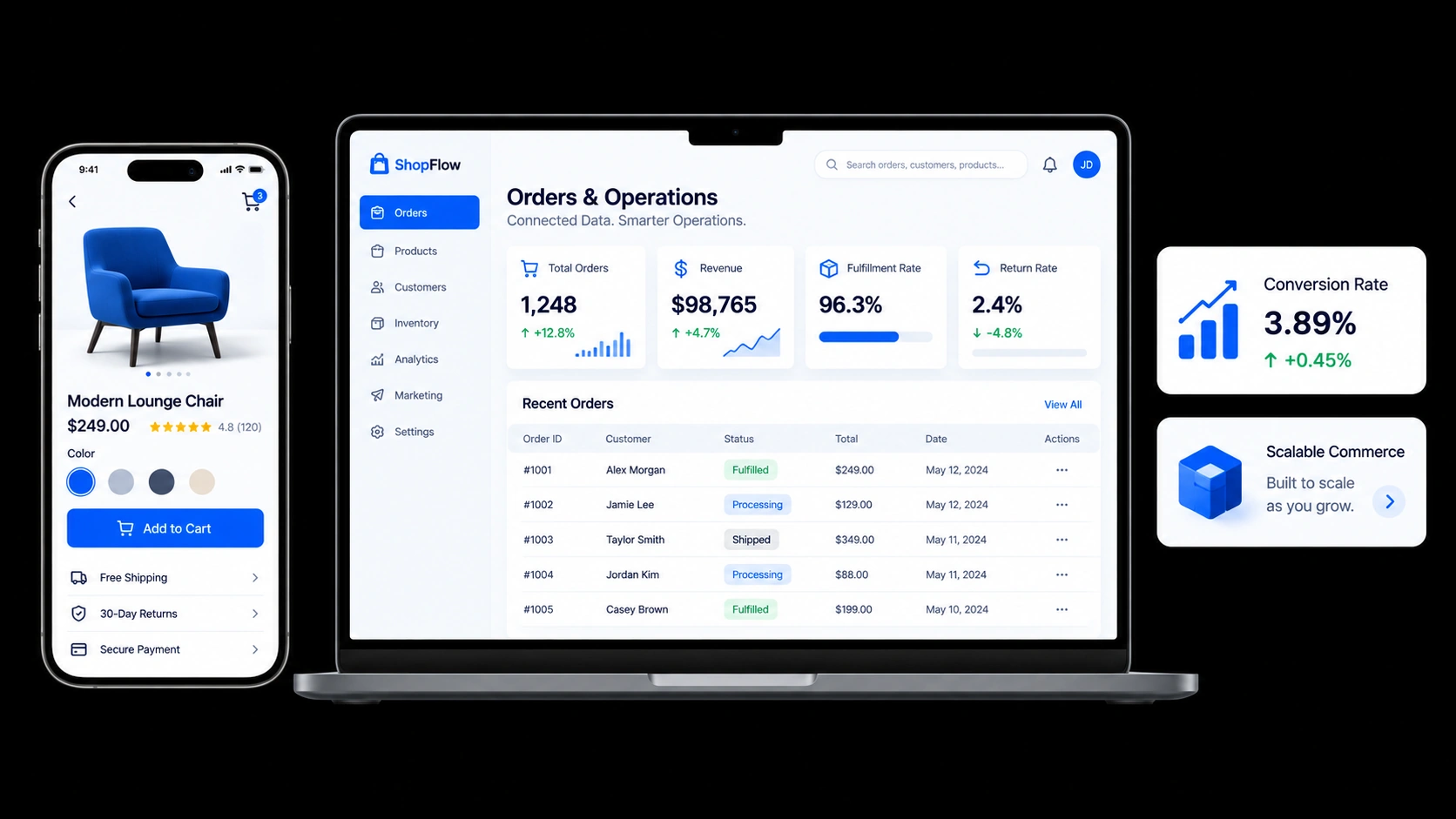
COMMERCE DIRECTIONS
Different business models need different buying systems.
These are common experience directions—not fixed packages. Catalogue, customer behavior and operational complexity should determine the store architecture.
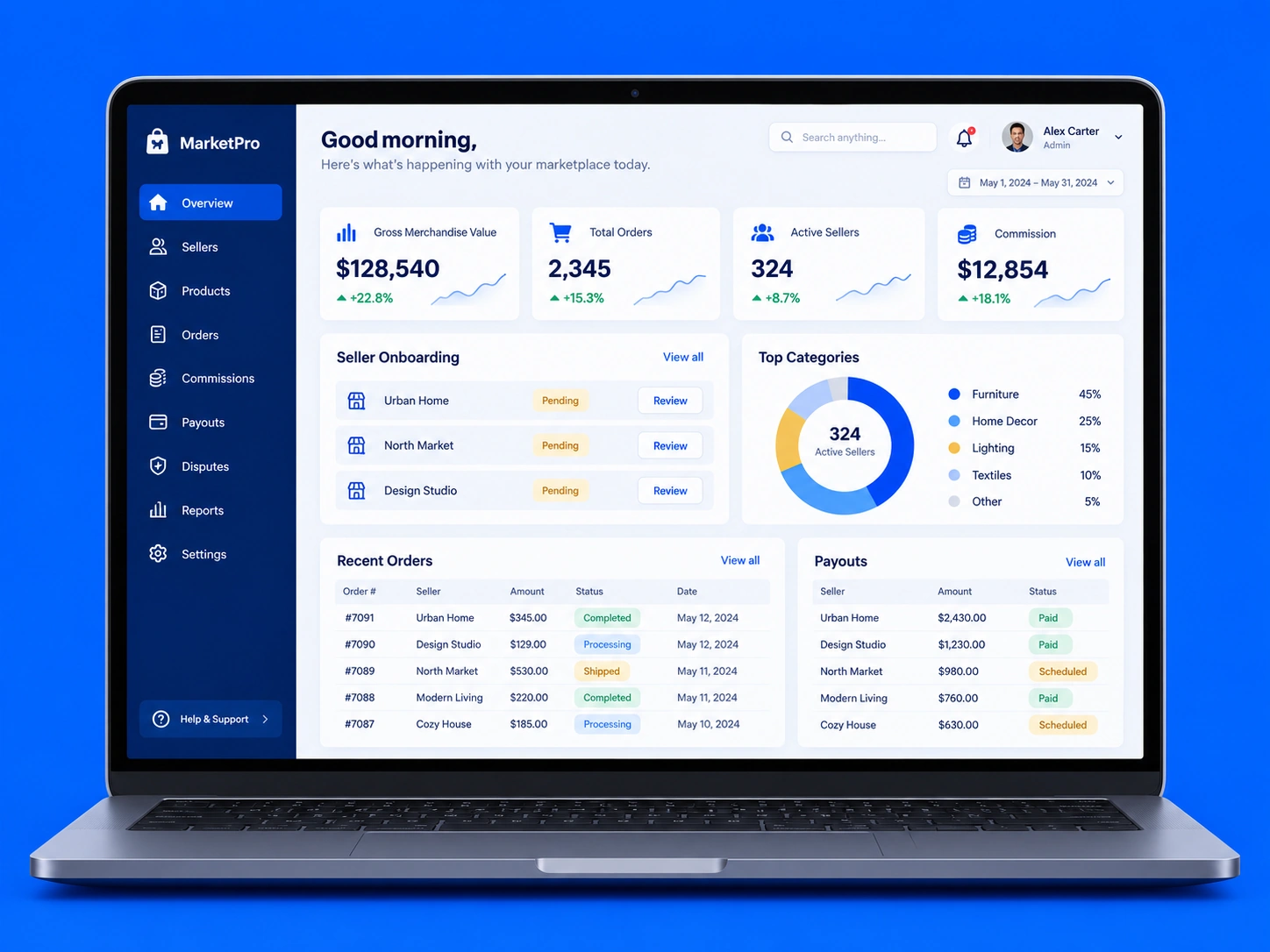
D2C & LIFESTYLE
Merchandising-led shopping with strong product storytelling.
Collections, campaigns, rich product media, bundles and repeat purchase.
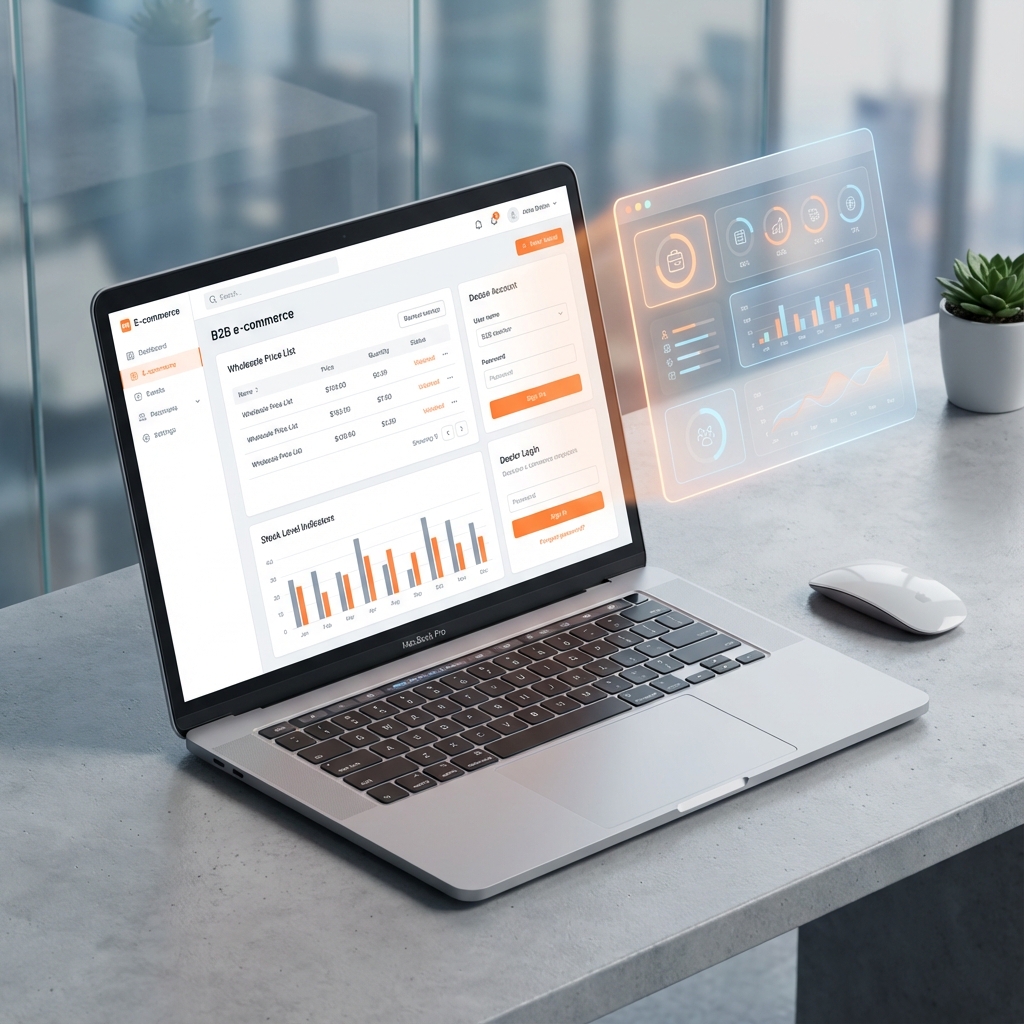
B2B & WHOLESALE
Account-aware commerce for repeat business buyers.
Pricing, terms, approvals, bulk ordering and operational visibility.
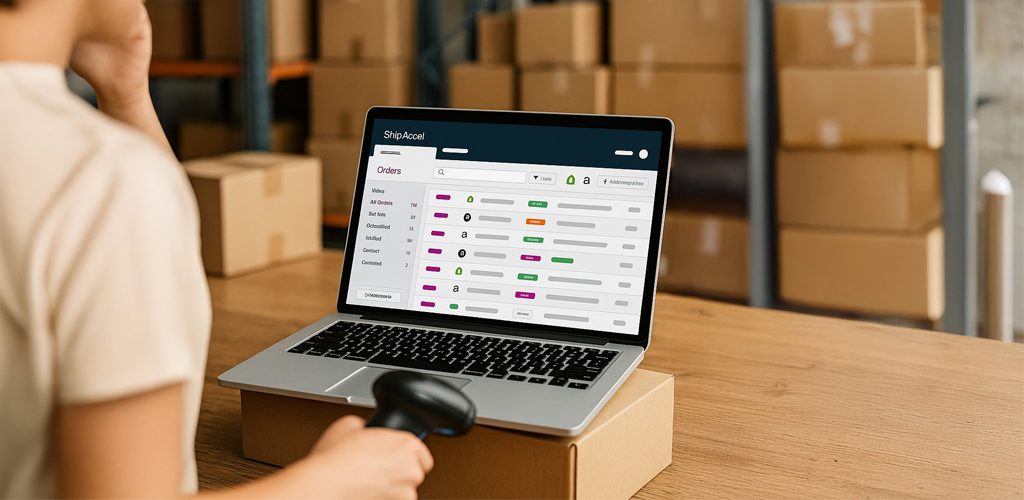
OPERATIONS-HEAVY COMMERCE
Storefront and fulfilment designed as one connected workflow.
Orders, inventory, labels, tracking, service and reconciliation.
TECHNOLOGY ECOSYSTEM
Use the smallest reliable stack that supports the actual business model.
We prefer clear ownership and deliberate integrations over plugin sprawl. Extensions are selected when they solve a real requirement; custom code is used where product logic genuinely differs.
WooCommerce
Core catalogue, cart, checkout, orders and extension ecosystem.
WordPress
Content, blocks, editorial workflows and CMS ownership.
REST & Webhooks
Integrations, automation and external system communication.
Payments
Razorpay, Stripe, PayPal and region-specific gateway flows.
ERP / CRM
Order, inventory, customer and financial system integration.
Cloudflare / CDN
Edge delivery, caching, security and traffic protection.
MySQL
Commerce data, order storage, queries and database tuning.
Monitoring
Logs, uptime, errors, performance and release visibility.
INDUSTRIES & COMMERCE MODELS
Shape the store around how the category is actually bought.
Merchandising, trust, fulfilment and repeat purchase are different in every category. The store structure should reflect those differences rather than forcing every business into one template.
Variants, fit, collections and high-visual merchandising.
Size guidance, colour variants, returns, seasonal drops, bundles and cross-sell.
Education, routines and replenishment-led buying.
Ingredients, usage guidance, bundles, subscriptions and repeat-order journeys.
Availability, delivery zones and frequent repeat purchase.
Freshness, local fulfilment, scheduled delivery, subscriptions and reorder.
High-consideration products with logistics complexity.
Dimensions, configuration, rich media, delivery rules and service-area logic.
Recurring value beyond the first checkout.
Plans, frequency, skips, upgrades, billing recovery and retention.
Fast repeat ordering and account-specific rules.
Pricing, tax, minimum order, approvals, quotes, credit terms and bulk order entry.
PLATFORM COMPARISON
Choose WooCommerce for the reasons that match your operating model.
No commerce platform is universally best. The decision should reflect ownership, customisation, team capability, speed to market and operational complexity.
| Decision factor | WooCommerce | Shopify | Magento / Adobe Commerce |
|---|---|---|---|
| Platform control | High control over hosting, code and data | Managed platform with defined constraints | High control with heavier operational needs |
| Customisation | Deep WordPress and PHP extensibility | Strong ecosystem inside platform boundaries | Very deep enterprise customisation |
| Content + commerce | Strong when WordPress content is central | Commerce-first with integrated content tools | Powerful commerce, implementation-heavy |
| Maintenance responsibility | Owner manages hosting, updates and security | Much is managed by the platform | Requires experienced technical operations |
| Typical fit | Brands wanting flexibility, ownership and custom workflows | Teams prioritising speed and managed simplicity | Large, complex enterprise commerce programmes |
DELIVERABLES LEDGER
What your team receives.
Outputs are organised around what customers need to use and what your internal team needs to operate after launch.
Commerce architecture
Catalogue · roles · workflows · integrations · hostingDocumented platform decisions and ownership boundaries before implementation.
Storefront UX & responsive UI
Discovery · PDP · cart · checkout · accountCustomer-facing journeys designed across desktop, tablet and mobile.
Theme, blocks & custom functionality
Frontend · plugins · APIs · automationProduction-ready engineering aligned with the approved commerce model.
Migration & integration assets
Mapping · scripts · redirects · sync · validationControlled data movement and integration logic with reconciliation steps.
QA, launch & operating documentation
Devices · orders · payments · monitoring · runbookLaunch readiness, handover and clear post-launch ownership for the internal team.
DELIVERY PROCESS
From commercial model to launch and continuous improvement.
The process keeps product, operations and engineering decisions visible so the store does not become a disconnected set of technical tasks.
Discover
Business model, customers, products, operational workflows, integrations and goals.
Architect
Catalogue, roles, checkout, data, extensions, custom code and hosting decisions.
Design & build
Storefront UX, responsive UI, theme, blocks, plugins and integrations.
Validate
Orders, payments, shipping, tax, devices, migration, security and performance.
Launch & optimise
Deployment, monitoring, funnel analysis, support and planned improvements.
ENGAGEMENT SHAPES
Work with us for the whole store or the part that is blocking growth.
Scope can range from a focused checkout or performance engagement to a complete migration and store rebuild.
New WooCommerce buildStrategy → launch
Store redesign / CROUX → engineering
Migration programmeData → go-live
Custom plugin / integrationFocused engineering
Ongoing supportMonthly capacity
WHAT DRIVES COST
Complexity lives in workflows and integrations, not the number of pages.
Budget is shaped by the product model, checkout rules, operational systems, migration requirements and quality expectations.
Catalogue complexityProducts · variants · bundles
Commerce logicPricing · tax · subscription
IntegrationsPayments · ERP · CRM · shipping
Migration depthCustomers · orders · SEO
Performance & scaleTraffic · data · reliability
How much does WooCommerce development cost?
Cost depends on storefront design, catalogue complexity, custom workflows, integrations, migration, performance requirements and timeline. Discovery is used to create a responsible estimate rather than a generic package price.
How long does a custom WooCommerce project take?
A focused store can take several weeks, while a complex migration or highly integrated commerce platform may require multiple phases. Content readiness and third-party dependencies strongly affect timing.
Can AppsLoading handle design and development together?
Yes. An engagement can cover discovery, UX, interface design, custom theme development, plugins, integrations, migration, testing and launch support.
When is WooCommerce a strong platform choice?
WooCommerce is often a strong fit when WordPress content, platform ownership, deep customisation and control over hosting or integrations are important.
Should we use a custom theme or an existing theme?
A custom theme is useful when brand differentiation, performance, accessibility and maintainability matter. A quality existing theme can suit simpler scopes when carefully selected and constrained.
Can you build custom WooCommerce plugins?
Yes. We can build business-specific functionality and integrations while keeping responsibilities clear and avoiding unnecessary dependence on overlapping extensions.
Can you migrate from Shopify, Magento or another platform?
Yes. Migration can include products, variants, customers, orders, content, images and selected operational data using a controlled mapping, validation and reconciliation process.
How do you protect SEO during migration?
We plan URL mapping, redirects, metadata, canonical handling, structured data and crawl checks. Search performance cannot be guaranteed, but disciplined preparation can reduce migration risk.
Will the old store stay available during development?
Normally the new store is developed in a staging environment while the current store continues operating. Final data synchronisation and launch steps are planned around business continuity.
Which payment gateways can you integrate?
Common integrations include Razorpay, Stripe, PayPal and other supported providers. The correct setup depends on region, currency, business model and compliance requirements.
Can WooCommerce support subscriptions, memberships and B2B?
Yes. WooCommerce can support recurring billing, gated access, account-specific pricing, approval workflows, bulk ordering and other specialised commerce models with suitable extensions or custom development.
Can you integrate shipping, ERP, CRM and inventory systems?
Yes. Integrations may use official extensions, APIs, webhooks, middleware or custom plugins depending on system capabilities, ownership and reliability requirements.
Can you improve a slow WooCommerce store?
Yes. We can assess themes, plugins, database activity, hosting, caching, scripts, images and checkout requests, then prioritise improvements by real user and operational impact.
How do you approach WooCommerce security?
Security work can include access controls, update practices, backups, monitoring, dependency review, secure hosting configuration and reducing unnecessary plugin exposure.
Do you provide maintenance after launch?
Yes. Ongoing support can include updates, backups, monitoring, fixes, performance work, integration maintenance and planned feature development.
READY TO BUILD A SERIOUS COMMERCE PLATFORM?
Create a WooCommerce store that customers can trust and your team can operate.
Share your catalogue, customer journeys, integrations and growth goals. AppsLoading can recommend the right architecture, delivery plan and launch path.
Storefront UXCheckoutSubscriptionsB2BIntegrationsMigration