

Latency rises as demand grows
Requests slow down under concurrency, expensive queries or synchronous background work.
Use the project contact page to share context and get routed to the right capability.
Open project contact →AppsLoading helps digital products scale across traffic, data, teams and markets. We remove measurable bottlenecks, strengthen cloud and database architecture, improve APIs, add caching and queues, validate capacity through load testing and build observability for stable long-term growth.
Growth problems rarely come from one layer. We map symptoms to measurable constraints so the team can fix what is actually limiting users, throughput, reliability or cost.
Requests slow down under concurrency, expensive queries or synchronous background work.
Launches, campaigns or seasonal demand push services toward saturation.
Indexes, query patterns, locks, connections or data growth begin constraining the product.
Over-provisioning, low cache hit rates and inefficient workloads reduce unit economics.
Metrics, logs and traces do not connect the user symptom to the responsible service.
We inspect the product as a connected system. Improving one layer only helps if that layer is actually on the critical path.
Rendering, bundles, assets, CDN strategy and browser work.
Core Web Vitals · cache headers · edge deliveryHot code paths, concurrency, synchronous work and memory pressure.
CPU · heap · thread/worker saturationLatency, payloads, fan-out calls, gateways and rate limits.
p95/p99 · error rate · dependency timingQueries, indexing, connections, locks, replication and caching.
query plans · I/O · cache hit · lock timeCompute, network, load balancing, auto-scaling and regional delivery.
utilisation · saturation · scaling lagTelemetry, alerting, release safety, runbooks and recovery.
SLOs · MTTR · rollback · incident readinessScaling does not automatically mean microservices, Kubernetes or a new cloud. We choose the smallest architectural change that produces the required capacity, reliability or cost improvement.
Profile frontend, application, API, database and infrastructure behaviour under real workloads.
Right-size compute, load balancing, auto-scaling, containers and regional delivery.
Improve query plans, indexes, connection strategy, caching, replication and partitioning.
Reduce fan-out, tune payloads, add batching, queues, rate limits and clearer service boundaries.
Validate concurrency, throughput, saturation, recovery and failure behaviour before demand arrives.
Connect metrics, logs, traces, SLOs, dashboards, alerts and incident response.
Capacity planning turns vague growth expectations into traffic, concurrency, data and failure assumptions that can be tested against measurable thresholds.
Peak and sustained demand by critical endpoint, journey and region.
Users, jobs, sessions, connections and queue depth under burst conditions.
Storage, write volume, reads, retention, replication and index growth.
Timeouts, retry storms, dependency loss, failover and degraded-mode targets.
Performance engineering is not simply “make the server bigger.” We profile the request path and remove the work that creates latency, contention or unnecessary resource consumption.
Baseline p50, p95 and p99 latency, throughput, error rate, resource use and user-facing timing.
Move non-critical processing to queues or background workers where product behaviour allows it.
Cache stable reads at the right layer while preserving freshness, invalidation and correctness.
Validate that the change improves user-visible performance and does not move the bottleneck elsewhere.
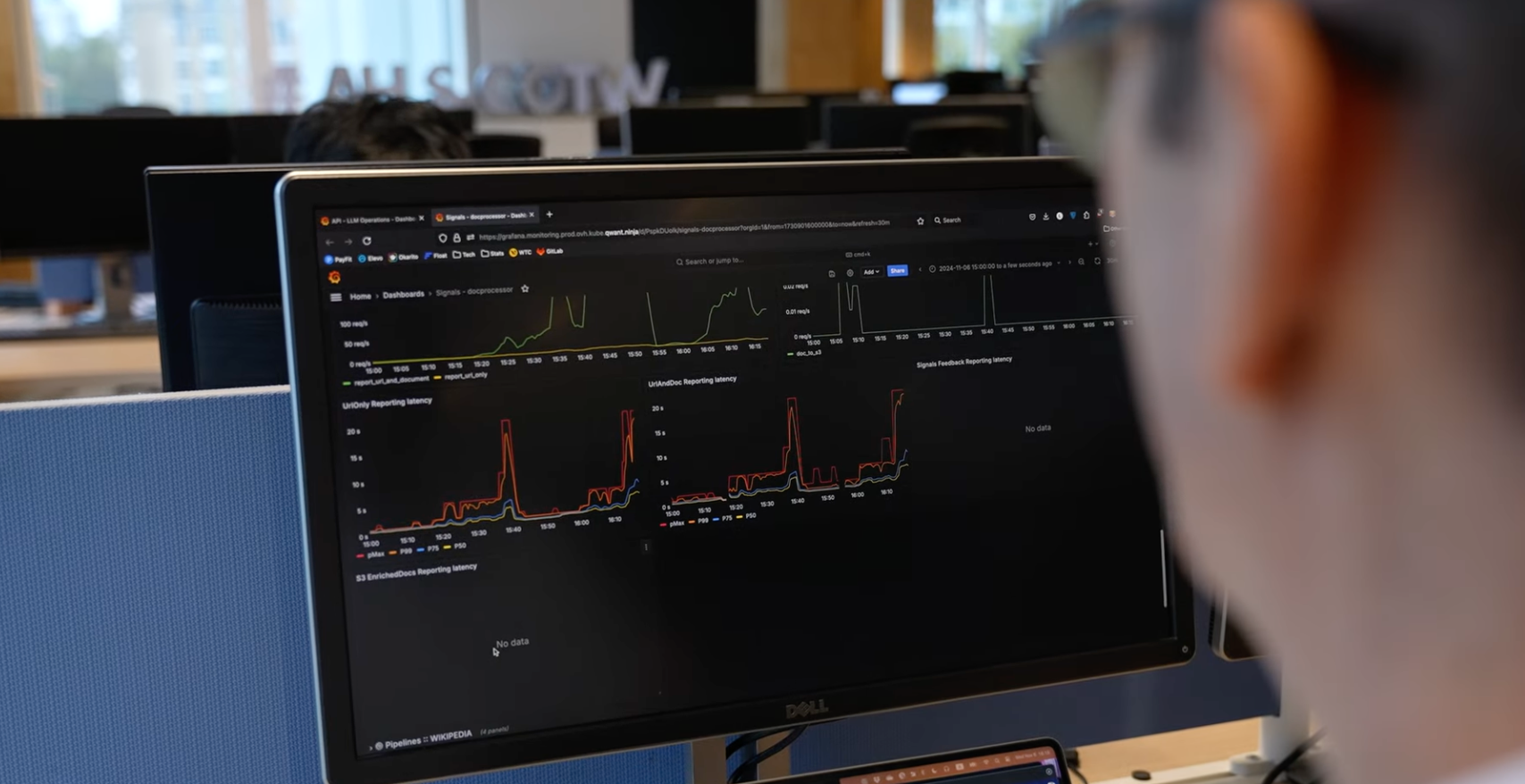
We reduce expensive reads and writes, improve query behavior, control connection pressure and make service interactions less sensitive to spikes.
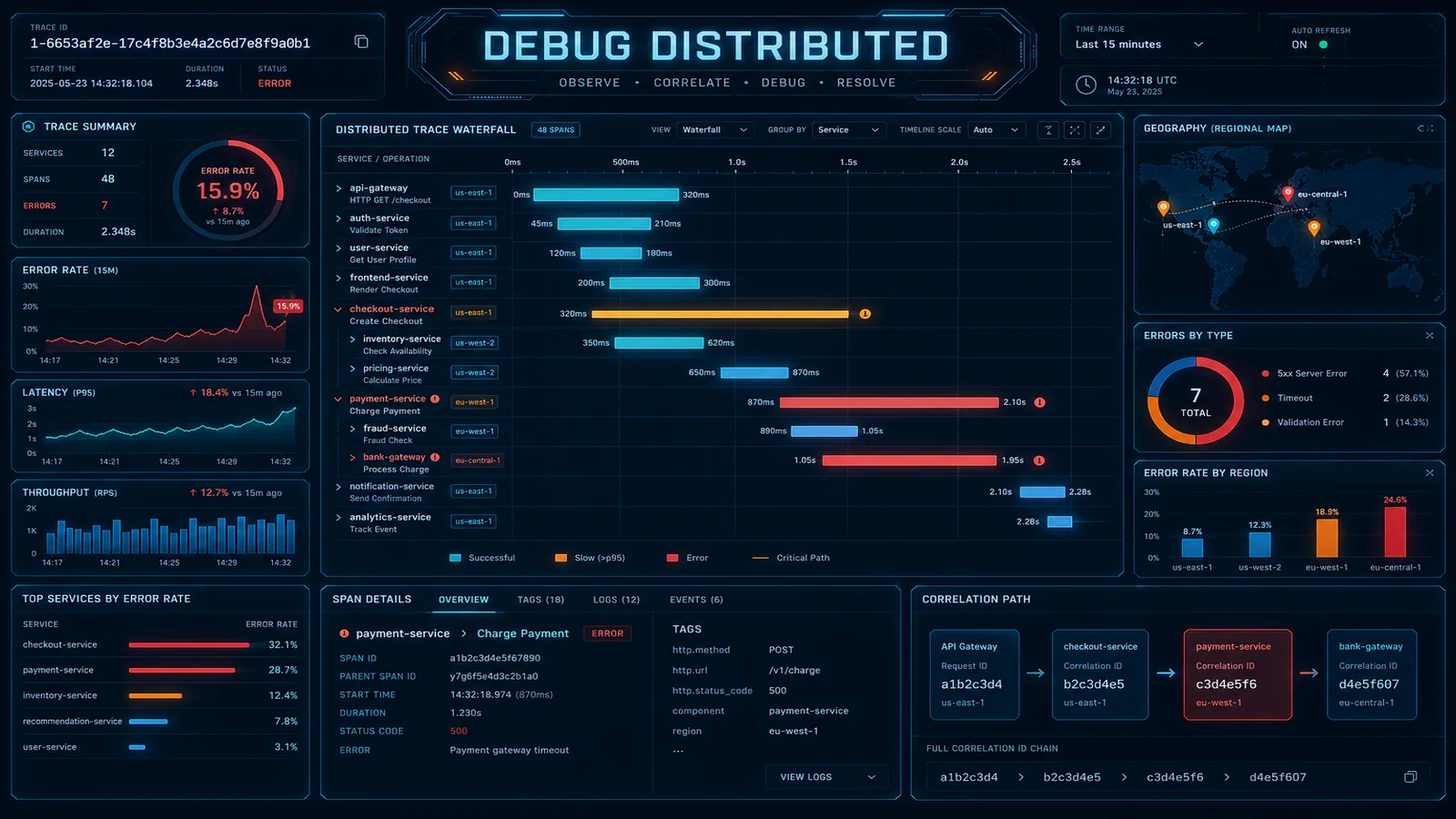
High throughput is not enough if one dependency failure creates a cascade. We design backpressure, timeouts, retries and recovery behavior so the product can remain predictable under stress.
Prevent slow dependencies from consuming the whole request budget or creating retry storms.
Absorb bursts and control how quickly downstream systems accept work.
Preserve critical journeys when a secondary service or feature is unavailable.
Test regional, infrastructure and data recovery assumptions before production incidents.
These programme shapes keep the work focused on the current constraint while leaving a clear path for the next stage of scale.
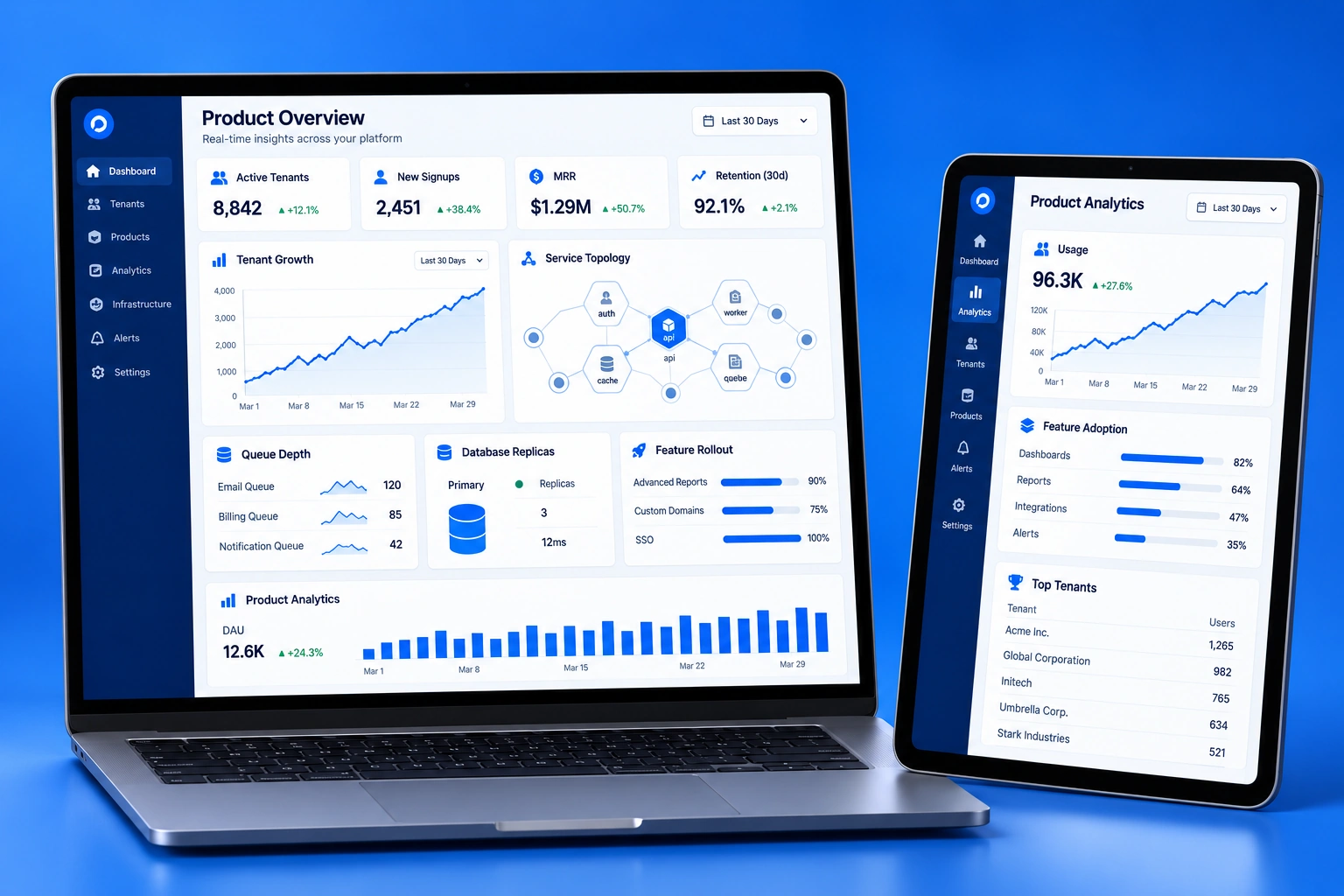
Performance baseline · workload model · APIs · database · queues · observability
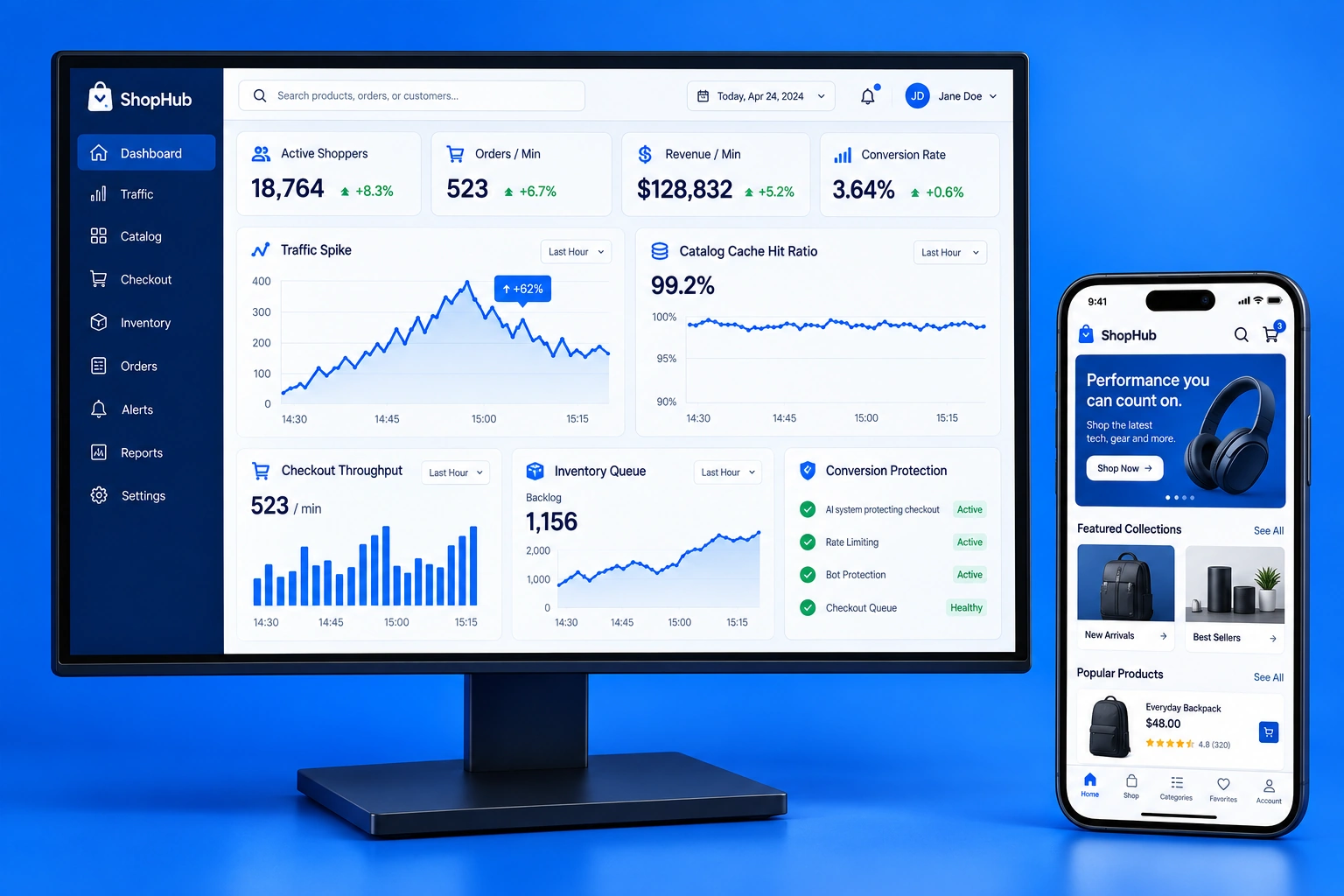
Load tests · cache · checkout path · capacity
Services · data · resilience · release safety
We connect user-facing symptoms to service health through metrics, logs and distributed traces, then build alerts around action rather than noise.

Outputs are tied to technical decisions and measurable thresholds rather than abstract architecture diagrams.
Evidence showing where the current system loses time, capacity or reliability.
A practical target design tied to current constraints and realistic growth.
Traffic scenarios, thresholds and test conditions for important user journeys.
Operational visibility that helps teams identify degradation before it becomes an outage.
Improvements sequenced by impact, effort, risk and expected growth stage.
The process keeps each technical change connected to a measurable bottleneck, target and validation step.
Review architecture, production telemetry, traffic, data, incidents and growth targets.
Define workload assumptions, critical paths, thresholds and failure conditions.
Improve the application, APIs, database, caches, queues and infrastructure.
Run load, stress and resilience tests against the agreed performance targets.
Monitor production behavior and evolve the architecture as demand changes.
Product scaling improves application, data, infrastructure and operational behavior so a digital product can support more traffic, users and complexity without unacceptable latency, instability or cost.
We use production telemetry, profiling, query analysis, infrastructure metrics and controlled load tests to trace the user-visible symptom to the constrained layer.
Before major traffic events or when latency, incidents, cloud cost, database pressure or deployment risk starts rising faster than expected.
Yes. Testing can cover sustained load, bursts, concurrency, saturation, recovery and important dependency failures.
Yes. We review application work, database access, external calls, payloads, caching, batching and background processing on the critical path.
We agree measurable targets such as p95 or p99 latency, throughput, error rate, saturation limits and recovery expectations for the journeys that matter.
Yes. Improvements can include query optimisation, indexing, connection management, caching, replication, partitioning and workload separation.
Yes. We work with major cloud platforms and choose services based on the current architecture, workload and operational requirements.
Often yes. Right-sizing, better caching, workload optimisation, storage tiers and more predictable auto-scaling can improve unit economics while preserving headroom.
Not automatically. Many products scale successfully by improving a modular monolith, database access, caching and infrastructure before introducing more distributed-system complexity.
Queues are useful for absorbing bursts, moving slow or retryable work out of synchronous requests and decoupling services that should not fail together.
Yes. We can plan regional delivery, failover, data placement, traffic routing and recovery behavior around the business continuity requirements.
Yes. Observability work can include metrics, logs, tracing, dashboards, alerts, service-level indicators and incident context.
Yes. We can strengthen CI/CD, environments, automated checks, staged releases, rollback and post-release monitoring.
Yes. Ongoing support can include performance review, capacity planning, observability, incident readiness, cloud cost review and architecture evolution.
Share your stack, traffic profile, production symptoms and growth target. AppsLoading can recommend the smallest high-impact scaling programme that gets the product safely to the next stage.

AppsLoading capabilities
AppsLoading helps startups, growing businesses and enterprise teams turn ideas, operational needs and outdated systems into dependable digital products. Our multidisciplinary teams support product strategy, user experience, mobile and web engineering, ecommerce, cloud infrastructure, enterprise automation, software modernization and long-term technical support.
Mobile application development: Native Android and iOS applications, Flutter and React Native products, cross-platform solutions, wearable experiences and mobile MVPs designed around adoption, reliability and future growth.
Website and web application development: Conversion-focused websites, WordPress builds, headless CMS platforms, progressive web apps, landing pages and custom web systems that remain fast, maintainable and easy to evolve.
Ecommerce engineering: Shopify, WooCommerce, Magento, headless commerce, multi-vendor marketplaces, catalogue systems, checkout journeys and secure payment integrations connected to business operations.
Custom and enterprise software: ERP, CRM, customer portals, operational dashboards, workflow automation, system integration and legacy modernization shaped around how teams, data and customers actually move through the business.
Product design and validation: Product strategy, UX research, interface design, prototypes, usability testing and design systems that reduce uncertainty before engineering investment increases.
Cloud, DevOps and support: AWS, Azure and Google Cloud architecture, CI/CD implementation, DevOps automation, application maintenance, performance optimization and flexible technical teams.
Startups and founders: Validate important assumptions, define an achievable MVP, launch with a maintainable foundation and build the measurement needed for the next product decision.
Growing businesses: Replace fragmented tools, improve customer journeys, automate repetitive workflows and add scalable software capacity without rebuilding the entire organization.
Enterprise teams: Modernize legacy systems, connect platforms and data, strengthen delivery infrastructure and introduce new digital services while managing security, continuity and operational complexity.
Digital product teams: Add specialized designers, mobile engineers, web developers, cloud professionals and QA support to extend internal delivery capability around a defined roadmap.
Yes. Engagements can cover discovery, product design, engineering, cloud, integrations, release support and continuous improvement through one coordinated team.
Yes. Teams can audit, modernize, redesign, optimize or extend an existing application without requiring a complete rebuild when an incremental path is more practical.
Yes. Delivery models can be adjusted for MVP validation, fixed-scope product work, long-term development, specialist augmentation or complex enterprise modernization.
Industry solutions
Industry software succeeds when technology reflects the people, processes, regulations, data and commercial realities around it. AppsLoading combines product strategy, domain discovery, user experience, engineering, cloud and integration work to create software that fits actual operating conditions rather than generic feature lists.
Customer and user applications: Mobile apps, self-service portals, booking journeys, ordering systems, account experiences, notifications and personalized digital services designed around real user tasks.
Operational platforms: Internal dashboards, workflow systems, staff applications, inventory tools, scheduling, approvals, reporting and role-based systems that support day-to-day execution.
Data and system integration: APIs, payment systems, CRM, ERP, third-party services, legacy databases and external platforms connected through controlled and observable integrations.
Automation and modernization: Replace repetitive manual work, reduce fragmented processes, improve visibility and modernize aging systems without disrupting critical operations.
Security and reliability: Plan access control, data handling, auditability, resilience, monitoring and release processes according to the risk level and responsibilities of the industry.
Growth and continuous improvement: Measure user behaviour, operational performance and commercial outcomes, then improve the product through planned iterations and technical support.
Healthcare and wellness: Patient experiences, appointment flows, care coordination, staff tools, health data integrations and secure communication platforms.
Fintech and payments: Customer onboarding, account experiences, transaction journeys, payment integrations, operational dashboards and workflow automation.
E-commerce and retail: Storefronts, marketplaces, catalogue systems, checkout, loyalty, inventory connections, order management and customer service tooling.
Logistics and mobility: Booking, dispatch, tracking, route visibility, field applications, driver workflows, fleet operations and customer notifications.
Education and learning: Learning platforms, student and educator portals, assessments, content delivery, scheduling, communication and administration systems.
Real estate and professional services: Listings, lead management, document workflows, client portals, project visibility, scheduling and internal operational systems.
Yes. Discovery can cover user groups, workflows, business rules, risks, integrations, operational dependencies and the outcomes the software must support.
Yes. New digital products can be integrated with current CRM, ERP, payment, identity, data, communication and industry-specific platforms.
Yes. Complex industry products are often divided into controlled phases to reduce risk, validate assumptions and protect continuity.
Related services
A successful digital product often depends on more than one isolated service. AppsLoading connects product planning, experience design, application engineering, cloud infrastructure, integrations, quality, maintenance and growth support so each stage of delivery works with the next.
Discovery and product planning: Clarify users, business goals, risks, workflows, feature priorities, technical constraints and delivery milestones before unnecessary complexity enters the build.
UX and interface design: Translate requirements into user journeys, information architecture, wireframes, prototypes, usable interfaces and consistent design systems.
Application and backend engineering: Build maintainable mobile, web and business software supported by secure APIs, databases, integrations, authentication, notifications, analytics and administration tools.
Cloud and delivery infrastructure: Establish environments, automated build and release pipelines, monitoring, scalable cloud architecture and operational visibility appropriate to the product.
Modernization and integration: Connect new experiences to existing systems, improve unstable architecture, replace manual processes and modernize critical software in controlled phases.
Maintenance and product growth: Resolve production issues, support platform changes, improve performance, ship new capabilities and add specialist capacity as priorities evolve.
End-to-end product delivery: One coordinated team manages strategy, design, engineering, quality and launch around agreed outcomes and milestones.
Focused service engagement: Bring AppsLoading into a defined stage such as UX, mobile engineering, ecommerce, cloud, automation, modernization or maintenance.
Dedicated development team: Build longer-term capacity around your roadmap with a stable combination of specialists and transparent delivery routines.
Staff augmentation: Add individual engineers, designers or infrastructure specialists to an existing internal or partner-led team where delivery needs extra capability.
Yes. Most engagements combine the primary service with selected design, backend, cloud, integration, testing, maintenance or optimization support.
Yes. The team can review documentation, code, architecture, design and delivery risks before proposing a practical transition or improvement plan.
Yes. Support can include monitoring, updates, issue resolution, performance work, feature development and planned product iterations.