

User experience
LCP, INP, CLS, launch time and interaction latency.
Use the project contact page to share context and get routed to the right capability.
Open project contact →AppsLoading improves websites, mobile apps, SaaS products, APIs, databases and cloud infrastructure using measurable performance engineering. We trace the complete request path, fix the constraints with the highest user and business impact, validate changes under load and protect the gains after release.
Visible lag can be caused by rendering, JavaScript, network waterfalls, service-to-service latency, database contention, cache misses, third-party dependencies or infrastructure saturation. We measure the whole path before changing architecture.



We create a baseline at the layers users actually touch and the layers engineering teams need to control.
LCP, INP, CLS, launch time and interaction latency.
Bundles, media, fonts, caching, rendering and main-thread work.
API latency, queues, concurrency and dependency timing.
Queries, indexes, locks, cache hit rate and connection pressure.
CPU, memory, network, autoscaling and regional placement.
Throughput, saturation, recovery and headroom under load.
Engage AppsLoading for a full performance programme or a focused bottleneck across one layer of the product.


Improve rendering, assets, scripts, caching, fonts and browser responsiveness.
Web · CWV
Profile complex dashboards, state updates, network waterfalls and browser work.
Web App · UX
Reduce service latency, queue delays, dependency overhead and inefficient business logic.
Backend · APIs
Improve queries, indexes, locks, schemas, caching and connection behavior.
Database · Queries
Improve startup, rendering, memory, requests, battery behavior and crash-prone journeys.
iOS · Android
Tune scaling, resource allocation, load balancing, CDN and infrastructure efficiency.
Cloud · Efficiency
Validate concurrency, throughput, saturation, endurance, failure and scaling limits.
Load · Capacity
Track production latency, budgets, alerts and performance drift after release.
Observability · BudgetsInstead of tuning isolated components, we connect browser or app timing to APIs, dependencies, data access and infrastructure. That reveals where time is actually being spent.
We connect CrUX or RUM evidence with lab profiling, network waterfalls and render analysis so LCP, INP and CLS work is based on the cause rather than the score alone.


We profile the main thread, JavaScript execution, layout, rendering, asset delivery and network waterfalls to remove work that users pay for on every visit.
Backend performance often hides inside serial calls, chatty services, queue delays, external dependencies, inefficient serialization and work that should happen asynchronously.


We use query plans, wait events, index analysis, connection behavior and workload patterns to improve the data path without blindly adding infrastructure.
We optimize the experience across real devices and weak networks, not only a powerful development machine.

Reduce blocking initialization, heavy startup work and unnecessary SDK setup.
Profile frames, list rendering, state updates and expensive visual work.
Find leaks, pressure, crashes and lifecycle issues across device classes.
Reduce payloads, retries, duplicate calls and slow request chains.

More compute can hide inefficient work. We separate capacity problems from architecture problems and tune the platform around actual traffic and utilization.
We design cache layers around data freshness, invalidation, personalization and failure behavior so performance gains remain correct and operationally safe.

We model realistic traffic, concurrency and business journeys to identify saturation points, queue growth, timeouts and recovery behavior.


Capacity planning connects business forecasts to throughput, concurrency, service limits, queue behavior and infrastructure resources.
Optimization is incomplete without visibility. We connect metrics, traces, logs, RUM and business events so regressions can be caught quickly.

We convert target performance into build and production guardrails so new code, scripts, media or dependencies cannot erode the gains unnoticed.

We connect technical performance improvements to measurable product and operational outcomes.
Four common performance engagements, each measured against a different set of user and system signals.

Field data, browser profiling and delivery optimization for public websites.

Rendering, API, query and background-work optimization for product interfaces.

Load testing, queues, caching, databases and cloud scaling for growth.

Budgets, RUM, traces and release checks that protect performance over time.
Start with a focused audit or run performance engineering as a recurring discipline.
Baseline, diagnosis and prioritized optimization roadmap.
Fix a defined web, API, database, mobile or cloud bottleneck.
Model traffic, test limits and improve saturation behavior.
Ongoing monitoring, budgets, regressions and optimization support.
We use the tooling that best fits the product stack and the layer being investigated.
Lab audits, rendering diagnostics and Core Web Vitals signals.
Field and lab data for critical web journeys.
Network waterfalls, filmstrips and repeatable browser testing.
APM, traces, dependencies and production performance.
Infrastructure, application, logs and distributed tracing.
Operational dashboards, metrics and alerting.
Load, stress, spike and endurance testing.
Vendor-neutral traces, metrics and instrumentation.
A structured programme with evidence, priorities, controlled change and repeatable validation.
Collect field, lab, application and infrastructure metrics.
MeasureFollow slow journeys through frontend, services and data.
DiagnoseRank improvements by impact, effort, risk and dependency.
PlanImplement focused improvements across the relevant layers.
EngineerValidate latency, throughput, saturation and failure behavior.
ValidateMonitor budgets, alerts and regressions after release.
ObserveDifferent products fail differently under latency and load. We tune the measures and tests to the user journey.

Launch, rendering, memory, network and device-level responsiveness.
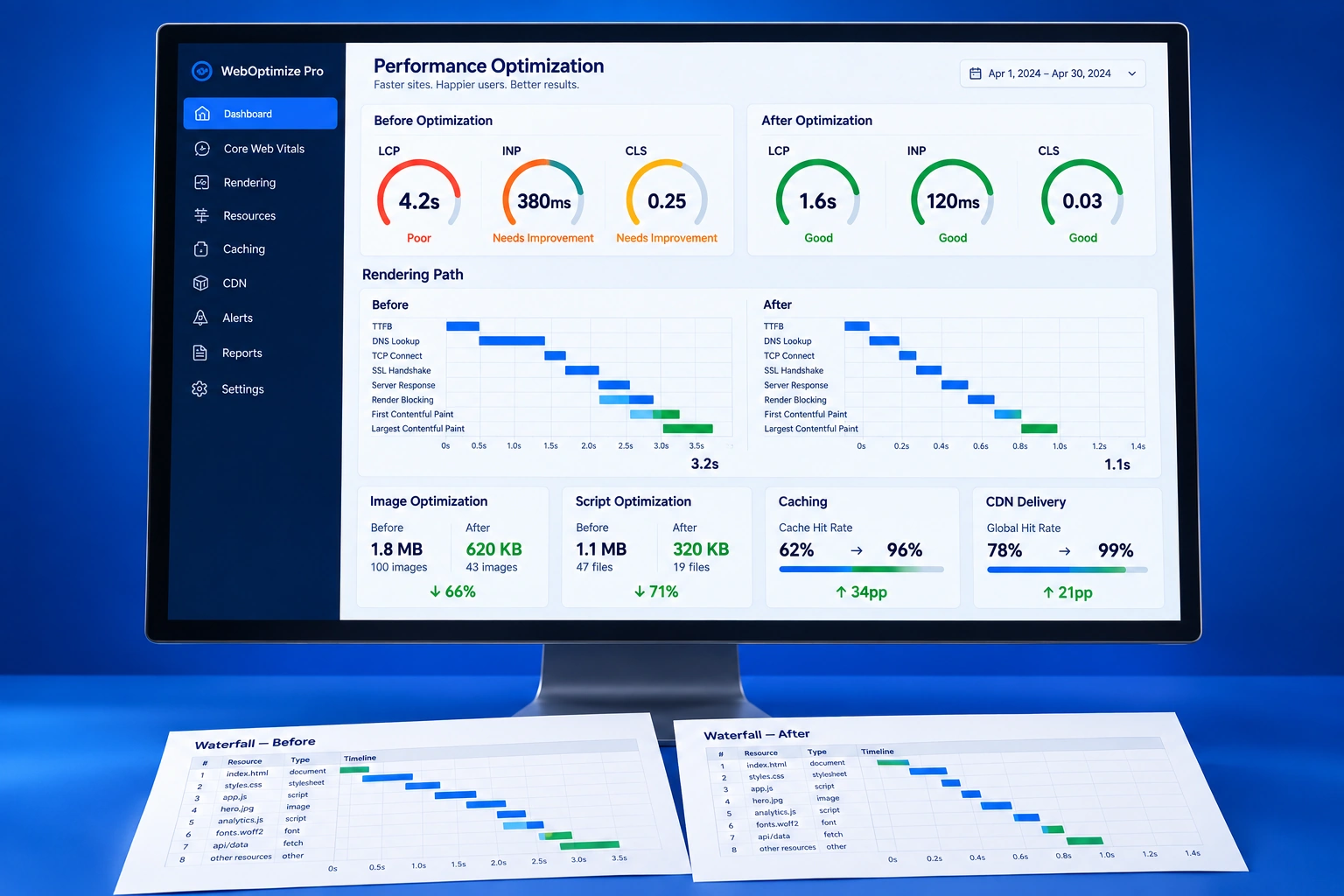
Frontend delivery, APIs, caching and load behavior during peaks.

Dashboards, services, queues, databases and multi-tenant capacity.
Deliverables connect technical evidence to clear priority, measurable change and long-term regression protection.
Field, lab, application and infrastructure metrics before optimization.
Evidence-backed root causes across the full request path.
Changes ranked by impact, effort, risk and dependency.
Approved frontend, backend, data, mobile and cloud changes.
Before-and-after results plus load and regression findings.
Budgets, dashboards, alerts and ongoing review recommendations.
We treat performance as an engineering system: establish the baseline, isolate the cause, change one or more layers deliberately, validate under realistic conditions and protect the outcome.
The amount of work depends on how many layers, journeys and traffic conditions need to be measured and improved.
Website, application, mobile, APIs, database and infrastructure involved.
Existing RUM, traces, logs, metrics and profiling access.
Current load, growth expectations, seasonality and event traffic.
Services, dependencies, queues, data stores and third parties.
Core Web Vitals, latency, throughput, capacity or cost goals.
Lab testing, field measurement, load testing and ongoing monitoring.
It can include frontend speed, Core Web Vitals, API latency, database tuning, mobile performance, cloud efficiency, load testing, capacity planning and observability.
We combine field data, lab tests, profiling, traces, logs, database analysis and controlled load testing so recommendations are supported by evidence.
Timing depends on product complexity, current observability, the number of slow journeys and whether implementation and load testing are included.
Yes. We improve LCP, INP and CLS through rendering, asset, script, caching, server-response and layout changes based on field and lab evidence.
Improved Core Web Vitals, page experience, crawl efficiency and loading behavior can support the technical quality of a site.
Yes. We can profile rendering, state updates, bundles, network requests, long tasks and API dependencies in interactive applications.
Yes. We review service logic, dependencies, database access, queues, caching, timeouts, serialization and infrastructure.
Yes. We review queries, plans, indexes, schemas, locks, transactions, connections, caches and workload patterns.
Yes. We measure dependency latency and can reduce its impact through timeouts, caching, batching, asynchronous work and fallback design.
Yes. We can test concurrency, throughput, saturation, spikes, endurance, failure behavior and recovery using realistic scenarios.
Often. Removing inefficient work, improving caching, right-sizing resources and tuning scaling can reduce the cost required for the same workload.
Yes. We can model expected traffic, test critical journeys and improve capacity, caching, queues, scaling and recovery before the event.
Yes. We can optimize launch time, rendering, memory, network usage, battery-sensitive work and crash-prone or janky workflows.
Yes. We can implement dashboards, alerts, traces, RUM and performance budgets to help detect regressions after release.
You retain ownership of approved code, configuration and documentation delivered as part of the engagement according to the agreement.
Share the journeys, metrics and traffic conditions that matter. We will recommend a practical performance audit and optimization plan.
Start your performance audit →AppsLoading capabilities
AppsLoading helps startups, growing businesses and enterprise teams turn ideas, operational needs and outdated systems into dependable digital products. Our multidisciplinary teams support product strategy, user experience, mobile and web engineering, ecommerce, cloud infrastructure, enterprise automation, software modernization and long-term technical support.
Mobile application development: Native Android and iOS applications, Flutter and React Native products, cross-platform solutions, wearable experiences and mobile MVPs designed around adoption, reliability and future growth.
Website and web application development: Conversion-focused websites, WordPress builds, headless CMS platforms, progressive web apps, landing pages and custom web systems that remain fast, maintainable and easy to evolve.
Ecommerce engineering: Shopify, WooCommerce, Magento, headless commerce, multi-vendor marketplaces, catalogue systems, checkout journeys and secure payment integrations connected to business operations.
Custom and enterprise software: ERP, CRM, customer portals, operational dashboards, workflow automation, system integration and legacy modernization shaped around how teams, data and customers actually move through the business.
Product design and validation: Product strategy, UX research, interface design, prototypes, usability testing and design systems that reduce uncertainty before engineering investment increases.
Cloud, DevOps and support: AWS, Azure and Google Cloud architecture, CI/CD implementation, DevOps automation, application maintenance, performance optimization and flexible technical teams.
Startups and founders: Validate important assumptions, define an achievable MVP, launch with a maintainable foundation and build the measurement needed for the next product decision.
Growing businesses: Replace fragmented tools, improve customer journeys, automate repetitive workflows and add scalable software capacity without rebuilding the entire organization.
Enterprise teams: Modernize legacy systems, connect platforms and data, strengthen delivery infrastructure and introduce new digital services while managing security, continuity and operational complexity.
Digital product teams: Add specialized designers, mobile engineers, web developers, cloud professionals and QA support to extend internal delivery capability around a defined roadmap.
Yes. Engagements can cover discovery, product design, engineering, cloud, integrations, release support and continuous improvement through one coordinated team.
Yes. Teams can audit, modernize, redesign, optimize or extend an existing application without requiring a complete rebuild when an incremental path is more practical.
Yes. Delivery models can be adjusted for MVP validation, fixed-scope product work, long-term development, specialist augmentation or complex enterprise modernization.
Industry solutions
Industry software succeeds when technology reflects the people, processes, regulations, data and commercial realities around it. AppsLoading combines product strategy, domain discovery, user experience, engineering, cloud and integration work to create software that fits actual operating conditions rather than generic feature lists.
Customer and user applications: Mobile apps, self-service portals, booking journeys, ordering systems, account experiences, notifications and personalized digital services designed around real user tasks.
Operational platforms: Internal dashboards, workflow systems, staff applications, inventory tools, scheduling, approvals, reporting and role-based systems that support day-to-day execution.
Data and system integration: APIs, payment systems, CRM, ERP, third-party services, legacy databases and external platforms connected through controlled and observable integrations.
Automation and modernization: Replace repetitive manual work, reduce fragmented processes, improve visibility and modernize aging systems without disrupting critical operations.
Security and reliability: Plan access control, data handling, auditability, resilience, monitoring and release processes according to the risk level and responsibilities of the industry.
Growth and continuous improvement: Measure user behaviour, operational performance and commercial outcomes, then improve the product through planned iterations and technical support.
Healthcare and wellness: Patient experiences, appointment flows, care coordination, staff tools, health data integrations and secure communication platforms.
Fintech and payments: Customer onboarding, account experiences, transaction journeys, payment integrations, operational dashboards and workflow automation.
E-commerce and retail: Storefronts, marketplaces, catalogue systems, checkout, loyalty, inventory connections, order management and customer service tooling.
Logistics and mobility: Booking, dispatch, tracking, route visibility, field applications, driver workflows, fleet operations and customer notifications.
Education and learning: Learning platforms, student and educator portals, assessments, content delivery, scheduling, communication and administration systems.
Real estate and professional services: Listings, lead management, document workflows, client portals, project visibility, scheduling and internal operational systems.
Yes. Discovery can cover user groups, workflows, business rules, risks, integrations, operational dependencies and the outcomes the software must support.
Yes. New digital products can be integrated with current CRM, ERP, payment, identity, data, communication and industry-specific platforms.
Yes. Complex industry products are often divided into controlled phases to reduce risk, validate assumptions and protect continuity.
Related services
A successful digital product often depends on more than one isolated service. AppsLoading connects product planning, experience design, application engineering, cloud infrastructure, integrations, quality, maintenance and growth support so each stage of delivery works with the next.
Discovery and product planning: Clarify users, business goals, risks, workflows, feature priorities, technical constraints and delivery milestones before unnecessary complexity enters the build.
UX and interface design: Translate requirements into user journeys, information architecture, wireframes, prototypes, usable interfaces and consistent design systems.
Application and backend engineering: Build maintainable mobile, web and business software supported by secure APIs, databases, integrations, authentication, notifications, analytics and administration tools.
Cloud and delivery infrastructure: Establish environments, automated build and release pipelines, monitoring, scalable cloud architecture and operational visibility appropriate to the product.
Modernization and integration: Connect new experiences to existing systems, improve unstable architecture, replace manual processes and modernize critical software in controlled phases.
Maintenance and product growth: Resolve production issues, support platform changes, improve performance, ship new capabilities and add specialist capacity as priorities evolve.
End-to-end product delivery: One coordinated team manages strategy, design, engineering, quality and launch around agreed outcomes and milestones.
Focused service engagement: Bring AppsLoading into a defined stage such as UX, mobile engineering, ecommerce, cloud, automation, modernization or maintenance.
Dedicated development team: Build longer-term capacity around your roadmap with a stable combination of specialists and transparent delivery routines.
Staff augmentation: Add individual engineers, designers or infrastructure specialists to an existing internal or partner-led team where delivery needs extra capability.
Yes. Most engagements combine the primary service with selected design, backend, cloud, integration, testing, maintenance or optimization support.
Yes. The team can review documentation, code, architecture, design and delivery risks before proposing a practical transition or improvement plan.
Yes. Support can include monitoring, updates, issue resolution, performance work, feature development and planned product iterations.