



Catalogue and product logic
Configurable products, bundles, attributes, categories, regional assortments and merchandising rules.
AppsLoading designs and engineers Magento 2 and Adobe Commerce platforms across storefront UX, B2B purchasing, multi-store operations, catalogues, search, checkout, custom extensions, ERP integrations, migrations, performance and long-term support.

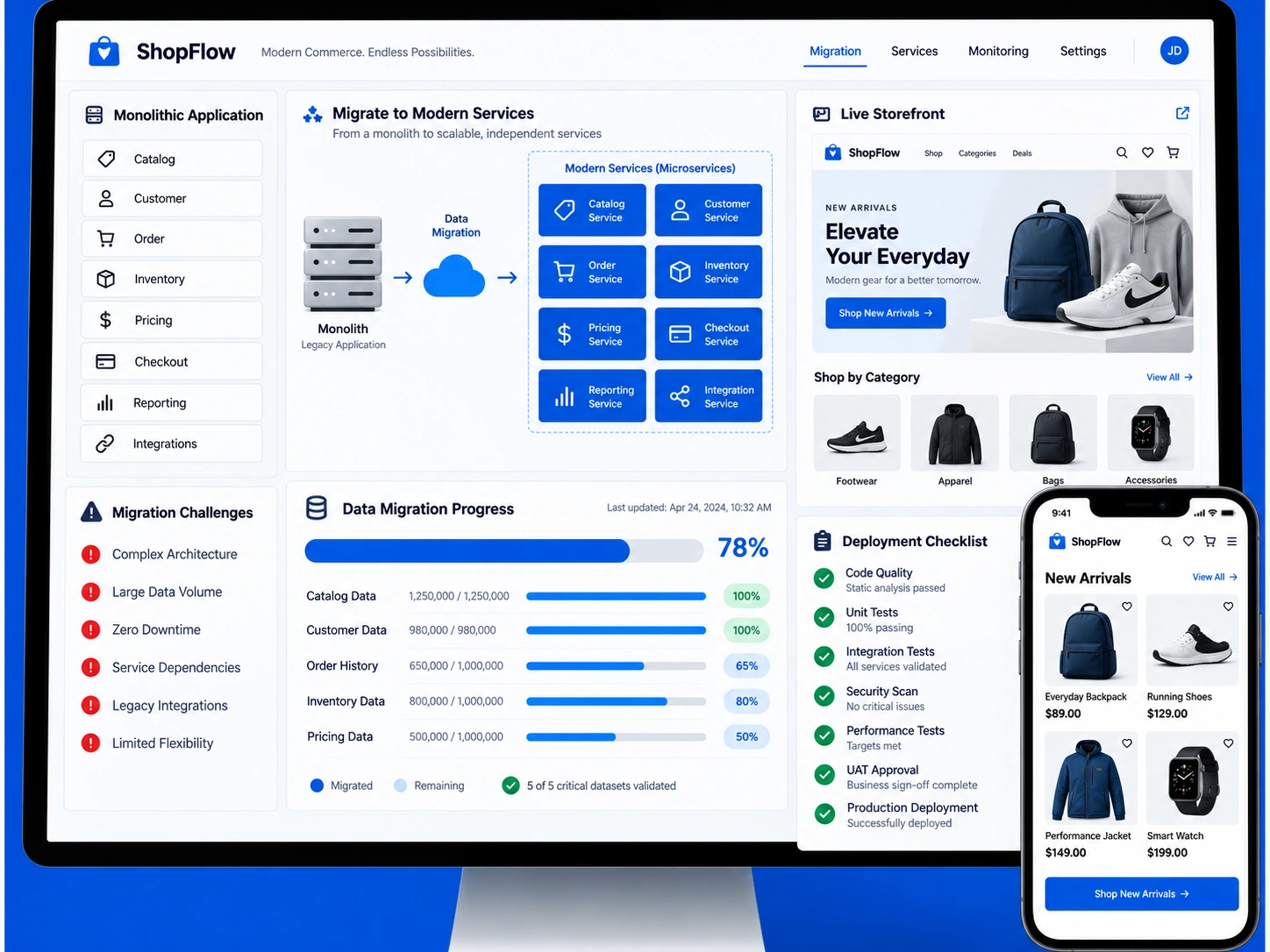

Magento gives teams deep flexibility, but flexibility needs structure. We separate experience, commerce logic, integrations and operational systems so future upgrades do not become a rebuild.
Hyvä, Luma, PWA or custom frontend based on commercial and performance needs.
Keep business-critical commerce behavior explicit and upgradeable.
Elasticsearch/OpenSearch, attribute strategy, relevance and merchandising controls.
Reliable exchange between Magento and ERP, CRM, PIM, WMS, tax, payment and shipping.
Clear ownership prevents sync conflicts and keeps support teams out of manual reconciliation.

Use AppsLoading for an end-to-end commerce build or for a focused area where architecture, UX, migration, integration or platform performance needs deeper expertise.
Catalogue, users, pricing, checkout, integrations, infrastructure, content and delivery planning.
Responsive product discovery, PDPs, cart, checkout, account, content and campaign experiences.
Enterprise B2C and B2B capabilities configured around governance, teams and operational complexity.
Company accounts, buyer roles, contract pricing, requisition lists, quotes, approvals and repeat ordering.
Business-specific workflows and capabilities built with clear boundaries and upgradeability in mind.
APIs, webhooks, queues, middleware and reconciliation across the commerce operating stack.
Products, customers, orders, content, SEO, modules and integrations moved with controlled validation.
Frontend delivery, caching, database, search, code, monitoring, patching and continuous optimisation.
Large catalogues and complex rules should not create a heavy experience. We design hierarchy, merchandising, search, product detail and checkout so customers see decisions, not platform complexity.

Navigation, campaigns, collections and product storytelling should work together rather than compete.



Magento can manage deep product structures. The UX still needs to translate those structures into useful filters, comparisons, recommendations and availability signals.
Structure data around how buyers compare products, not just how internal systems store them.
Relevance, faceting, category logic and synonyms tuned to catalogue behavior.
Campaign visibility, ranking, cross-sell and segment-specific merchandising controls.
Stock, source, lead time and delivery expectations shown without misleading the customer.
B2B Magento needs to support organizations, roles, purchasing rules and account-specific commercial agreements while still feeling fast enough for frequent repeat buyers.
Separate organizations, branches, buyers, approvers and purchasing permissions.
Customer-specific price books, assortments, volume rules and tax treatment.
Negotiation, purchase approvals, budget checks and internal procurement controls.
SKU entry, requisition lists, saved carts, order templates and account history.
Purchase orders, credit limits, invoices and account-aware settlement rules.


Magento multi-store can support multiple brands, countries, languages and business models from one platform. The design challenge is deciding which data and workflows are global and which belong to each market.
Shared products with market-specific availability, assortment or attributes.
Currency, regional price books, promotions, B2B contracts and tax behavior.
Shared components with local messaging, campaign calendars and translations.
Regional inventory, shipping, customer service and fulfilment ownership.
Permissions and workflows that keep local teams fast without fragmenting the platform.
Reliable commerce depends on more than a working API. Ownership, timing, retries, error handling and reconciliation matter when product, stock, price, customer and order data move between systems.
Orders, pricing, finance, customer terms and master data.
Product information, enrichment, attributes and media governance.
Sources, availability, reservation, picking and stock movement.
Accounts, customer context, sales activity and service history.
Catalogue · pricing · cart · checkout · orders · accounts · promotions
Authorisation, capture, authentication, refunds and settlement events.
Rates, service selection, labels, tracking and delivery promises.
Region-aware calculation, exemptions and transaction records.
Commercial, customer and operational events for reporting.
Migration touches product data, customer history, SEO, integrations, promotions, operational procedures and the workflows teams rely on every day. We treat cutover as a controlled business transition.
Map data, modules, custom code, integrations, URLs, scheduled jobs and operational dependencies.
Remove redundant extensions, dead logic, outdated content and customisations that no longer create value.
Products, customers, orders and content are migrated through repeatable scripts with reconciliation checks.
Preserve URL intent, redirects, metadata, canonical rules, structured data and crawl accessibility.
Cutover, delta data, integrations, payment checks and rollback responsibilities are agreed before launch.

The migration plan changes with data quality, custom modules, integrations, SEO risk and how much operational behavior should be redesigned.
Large catalogues, custom modules, search, third-party integrations and campaign traffic can expose bottlenecks across both frontend and backend. We measure the request path before deciding where optimisation should happen.
Rendering, scripts, media, theme behavior and caching.
Slow observers, plugins, queries and custom extension behavior.
Indexes, query patterns, Elasticsearch/OpenSearch and catalogue operations.
Redis, Varnish, RabbitMQ, CDN, autoscaling and background work.

The platform can support many operating models, but B2C retail, wholesale, multi-brand and hybrid commerce should not be forced through one generic feature map.

Catalogue experience, campaign speed, fulfilment visibility and conversion performance.

Commerce designed around organizations and purchasing rules.

Store views, catalogues, content, currencies and governance.
Technology choices are made around catalogue size, traffic, deployment model, search, integration reliability, frontend requirements and the skills your team needs to maintain.
 Magento 2
 Adobe Commerce
 PHP
 MySQL
 Redis
 GraphQL
Delivery should leave behind more than deployed code. Your team needs decisions, ownership and operating clarity so the platform remains maintainable after launch.
Platform boundaries, integration ownership, data flows, store structure, module responsibilities and infrastructure assumptions.
Responsive patterns for navigation, search, product detail, cart, checkout, account and campaign experiences.
Themes, modules, business rules, APIs and integrations implemented around agreed responsibilities.
Mapping, scripts, reconciliation checks, redirects, cutover steps and launch verification where migration is in scope.
Functional test coverage, integration checks, performance findings, browser/device validation and launch readiness criteria.
Documentation, deployment guidance, admin workflows, monitoring ownership and a backlog for post-launch improvements.
Our process separates business discovery, architecture, experience design, implementation, validation and launch so scope and risk remain visible throughout delivery.
Products, customer types, markets, pricing, operations, current systems, pain points and success measures.
Store structure, product model, roles, integrations, ownership, infrastructure and migration strategy.
Search, navigation, PDP, account, B2B workflow, checkout and responsive component design.
Theme, modules, APIs, integrations, content structures, environments and deployment automation.
Functional, integration, migration, security, browser, device and performance validation.
Cutover, monitoring, incident ownership, post-launch improvements and planned platform evolution.
A catalogue with simple pricing and few integrations behaves very differently from multi-region B2B commerce with account pricing, ERP ownership and heavy custom workflows.

Product types, attributes, variants, bundles, rules, regional assortment and data quality.
Company roles, contract pricing, approvals, quotes, purchase orders and credit terms.
ERP, PIM, CRM, WMS, payment, tax, shipping and the reliability expectations around each connection.
Data volume, SEO, module replacement, historical orders and the amount of behavior that must be preserved.
Traffic profile, campaign spikes, catalogue indexing, search volume, queue workloads and deployment model.
Instead of forcing every Magento project into one package, scope should show what is standard configuration, what is custom engineering, what is integration work and what creates ongoing operational cost.
Magento is often considered when catalogue depth, purchasing workflows, regional operations or system integrations create requirements beyond a simple online store.
Seasonal merchandising, variants, campaigns, content, promotions and high-volume product discovery.
Merchandising · DTC · multi-brandTechnical specifications, configurable products, accessories, comparison and availability-driven purchase decisions.
Complex catalogue · searchLarge SKU counts, compatibility logic, faceted discovery and dealer or wholesale account workflows.
Fitment · B2B · PIMAccount pricing, bulk ordering, technical product data, approvals and ERP-led operations.
B2B · ERP · procurementVariants, rich product media, delivery rules, regional stock and long-consideration product journeys.
Visual commerce · fulfilmentShared platform services with distinct storefronts, regional campaigns and central operational governance.
Multi-store · globalCost depends on catalogue complexity, storefront design, B2B workflows, custom modules, integrations, migration, infrastructure, performance requirements and timeline. Discovery is used to separate configuration from custom engineering and integration work.
A focused implementation may take several weeks, while a large Adobe Commerce, B2B or migration programme can require multiple phases. Data readiness, integrations and custom workflows strongly affect timing.
Yes. An engagement can cover discovery, solution architecture, UX/UI, Magento engineering, extension development, integrations, migration, QA, performance and launch support.
Both use the Magento platform foundation. Adobe Commerce adds enterprise capabilities and commercial services that may be useful for larger B2B, content, merchandising and operational requirements. The right choice depends on the required capabilities and operating model.
Yes. Frontend architecture can use Hyvä, a conventional Magento theme or a headless approach. The choice should follow performance, content, team skills, integration and maintenance requirements rather than frontend fashion.
Yes. We can build custom modules for business-specific workflows while keeping responsibilities explicit and reducing unnecessary coupling to Magento core or unrelated extensions.
Yes. Magento and Adobe Commerce can support company accounts, role-based buyers, customer-specific catalogues, negotiated pricing, quotes, approval workflows, bulk ordering and repeat procurement patterns.
Yes. Magento can support multiple websites, stores and store views with shared or market-specific catalogues, pricing, currencies, content and configuration. Governance should be designed so regional flexibility does not create platform fragmentation.
Yes, where the catalogue and operational model make that sensible. The UX, pricing, account rules and checkout behavior can differ by customer type while sharing selected platform capabilities.
Yes. Migration can include products, customers, orders, content, images, selected custom data, SEO mappings and integrations using a controlled mapping, validation and launch plan.
Yes. Integrations may use REST, GraphQL, webhooks, queues, middleware or system-specific connectors. The design should define data ownership, sync timing, retries, monitoring and reconciliation rather than relying only on successful API calls.
We plan URL mapping, redirects, canonical behavior, metadata, structured data, crawl accessibility and validation before and after cutover. Search performance cannot be guaranteed, but migration risk can be reduced through controlled preparation.
Yes. We can profile frontend delivery, themes, custom modules, database queries, search, cache behavior, queues, infrastructure and integrations, then prioritise improvements by measurable customer and operational impact.
Yes. Support can include dependency and patch planning, upgrade testing, access review, monitoring, backups, extension compatibility, incident work and scheduled platform maintenance.
Yes. Ongoing work can cover monitoring, bug fixes, performance, upgrades, security, integrations, conversion improvements and planned feature development.
Share your catalogue, customer types, current systems, markets and growth plans. AppsLoading can recommend the right Magento architecture, migration approach and delivery path.
